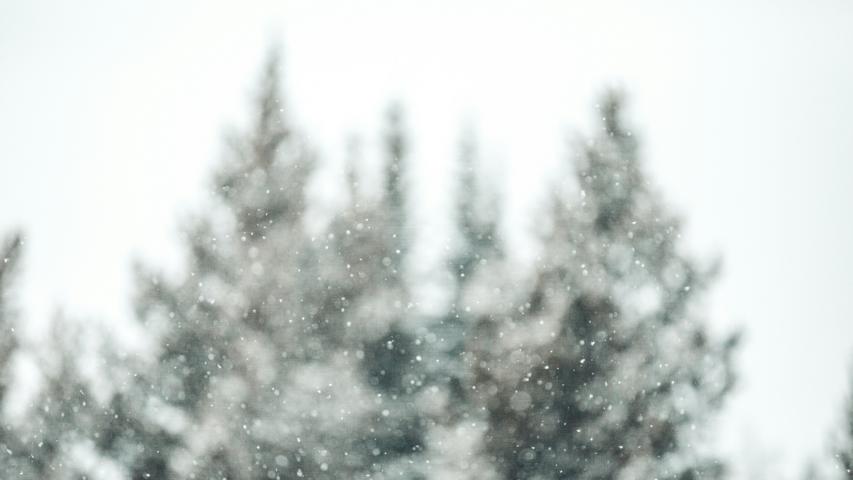
Unser Schnee .js Script erzeugt einen feinen, hochauflösenden und sehr realistischen Schneefall Effekt direkt in deinem Browser. Kein einfacher Overlay Effekt, sondern eine atmosphärische Szene mit Tiefe, Bewegung und Licht. Der Schnee wirkt ruhig, organisch und lebendig zugleich. So wie man ihn aus Filmvorspännen oder hochwertigen Landingpages kennt.
Mehrere Schneeschichten mit unterschiedlichen Größen und Geschwindigkeiten sorgen für räumliche Tiefe. Subtile Windfelder, Mikro-Turbulenzen und leichte Unschärfen lassen jede Flocke individuell und Einzigartig wirken. Nichts wiederholt sich sichtbar, nichts fühlt sich künstlich an.
Wenn Schnee nicht einfach nur „fallen“, sondern Stimmung in Kino Qualität erzeugen soll, ist dieses Script dafür gerade zu perfekt!
Cinematic-snow.js:
(() => {
    const canvas = document.getElementById('snow');
    const ctx = canvas.getContext('2d');

    let W, H, DPR;
    let flakes = [];
    let time = Math.random() * 10000;

    const SETTINGS = {
        layers: [
            { count: 90,  depth: 0.2, size: [0.5, 1.2], speed: 0.25 },
            { count: 140, depth: 0.45, size: [1.0, 2.2], speed: 0.6 },
            { count: 220, depth: 0.75, size: [1.8, 3.5], speed: 1.1 },
            { count: 120, depth: 1.0, size: [2.8, 5.0], speed: 1.6 }
        ]
    };

    function resize() {
        DPR = window.devicePixelRatio || 1;
        W = window.innerWidth;
        H = window.innerHeight;

        canvas.width = W * DPR;
        canvas.height = H * DPR;
        canvas.style.width = W + 'px';
        canvas.style.height = H + 'px';
        ctx.setTransform(DPR, 0, 0, DPR, 0, 0);
    }

    function rand(min, max) {
        return Math.random() * (max - min) + min;
    }

    class Snowflake {
        constructor(layer) {
            this.layer = layer;
            this.reset(true);
        }

        reset(init = false) {
            this.x = Math.random() * W;
            this.y = init ? Math.random() * H : -50;
            this.depth = this.layer.depth * rand(0.7, 1.3);

            this.size = rand(this.layer.size[0], this.layer.size[1]);
            this.speed = this.layer.speed * this.depth;

            this.turbulence = rand(0.6, 1.4);
            this.phase = Math.random() * Math.PI * 2;
            this.spin = rand(-0.015, 0.015);
            this.rotation = Math.random() * Math.PI * 2;

            this.opacity = 0.15 + this.depth * 0.75;
        }

        update(wind, gust) {
            this.phase += 0.008 * this.turbulence;
            this.rotation += this.spin;

            const microDrift = Math.sin(this.phase) * 0.35 * this.depth;
            const fall = this.speed * (1 + gust * 0.6);

            this.x += wind * this.depth + microDrift;
            this.y += fall;

            if (this.y > H + 60 || this.x < -80 || this.x > W + 80) {
                this.reset();
            }
        }

        draw() {
            ctx.save();

            const blur = (1 - this.depth) * 2.2;
            ctx.filter = blur > 0 ? `blur(${blur}px)` : 'none';

            ctx.globalAlpha = this.opacity;
            ctx.translate(this.x, this.y);
            ctx.rotate(this.rotation);

            const g = ctx.createRadialGradient(0, 0, 0, 0, 0, this.size);
            g.addColorStop(0, 'rgba(255,255,255,0.95)');
            g.addColorStop(0.4, 'rgba(255,255,255,0.55)');
            g.addColorStop(1, 'rgba(255,255,255,0)');

            ctx.fillStyle = g;
            ctx.beginPath();
            ctx.arc(0, 0, this.size, 0, Math.PI * 2);
            ctx.fill();

            ctx.restore();
        }
    }

    function build() {
        flakes = [];
        SETTINGS.layers.forEach(layer => {
            for (let i = 0; i < layer.count; i++) {
                flakes.push(new Snowflake(layer));
            }
        });
    }

    function wind(t) {
        return (
            Math.sin(t * 0.00025) * 0.8 +
            Math.sin(t * 0.0006) * 0.35 +
            Math.sin(t * 0.0012) * 0.15
        );
    }

    function gust(t) {
        return Math.max(0, Math.sin(t * 0.00015));
    }

    function vignette() {
        const g = ctx.createRadialGradient(
            W / 2, H / 2, Math.min(W, H) * 0.2,
            W / 2, H / 2, Math.max(W, H) * 0.7
        );
        g.addColorStop(0, 'rgba(0,0,0,0)');
        g.addColorStop(1, 'rgba(0,0,0,0.35)');
        ctx.fillStyle = g;
        ctx.fillRect(0, 0, W, H);
    }

    function frame(t) {
        ctx.clearRect(0, 0, W, H);

        time += 16;
        const w = wind(time);
        const g = gust(time);

        for (const f of flakes) {
            f.update(w, g);
            f.draw();
        }

        vignette();
        requestAnimationFrame(frame);
    }

    window.addEventListener('resize', () => {
        resize();
        build();
    });

    resize();
    build();
    requestAnimationFrame(frame);
})();